Wolf range hood and ventilation repair
You cannot see the air a hood moves, so most owners notice a problem late: smoke drifting past the canopy, a fan that sounds harder than it pulls, a downdraft that hesitates on its way up. A Wolf hood is a chain of filter, fan, motor, duct and controls, and the fix depends on which link has slipped.
Rated 4.9 out of 5 from 187 customer reviews · read them
Why is my Wolf range hood fan not working?
If nothing happens at any speed, check the breaker first, then whether the controls light up at all. Dead controls point to power, wiring or the control board; controls that respond while the fan stays still point to the blower motor, its capacitor or the speed control. A seized wheel can also stall a healthy motor.
What the hood is telling you
Ventilation faults rarely announce themselves with a code. These are the patterns we see on Wolf hoods and downdrafts, and the part each one usually leads back to.
-
Smoke and steam escape past the canopy even on high
Usually behind it: Clogged filters, a grease-loaded blower wheel, a duct that is crushed, too long or blocked at the exterior cap, or a motor that no longer reaches full speed.
The way forward: Clean the filters first. If draw is still weak with clean filters, the problem is past them.
-
Roaring, rattling or a rising whine
Usually behind it: Grease buildup throwing the blower wheel off balance, worn motor bearings, a loose mounting screw, or a damper flap knocking in the duct.
The way forward: Note which speed makes it worst. A noise that grows over weeks usually means bearings.
-
Every speed sounds and pulls about the same
Usually behind it: Speed control or the board that drives it, sometimes a motor winding that has failed on one tap.
The way forward: Try each speed for a minute. Report which ones actually change.
-
Hood lights out while the fan works
Usually behind it: Bulbs or LED modules, their sockets, the light switch, or the lighting circuit on the board.
The way forward: Replace a bulb if your use-and-care guide shows how. If a new bulb stays dark, the circuit needs testing.
-
Grease dripping or a sticky film inside the hood
Usually behind it: Filters overdue for cleaning, grease getting past a poorly seated filter, or a duct with too little slope letting grease pool.
The way forward: Stop using high heat under the hood until it is cleaned. A grease-loaded hood is a fire risk.
-
Buttons ignore you or the fan changes speed on its own
Usually behind it: Control panel, the board, or the heat sensor that drives automatic speed on models that have it.
The way forward: Switch the breaker off for a minute to reset the controls. If the behaviour returns, book a visit.
-
Hood shakes or hums against the cabinets
Usually behind it: Loose mounting, an unbalanced blower wheel, or a motor bracket that has worked free.
The way forward: Do not keep running a hood that visibly moves on its mounts.
-
Downdraft will not rise, stops halfway or will not lower
Usually behind it: Lift motor, its gear or the position switches that tell the control where the chimney is; sometimes debris in the guides.
The way forward: Look for anything resting on top of the chimney or wedged behind it. Do not force it by hand.
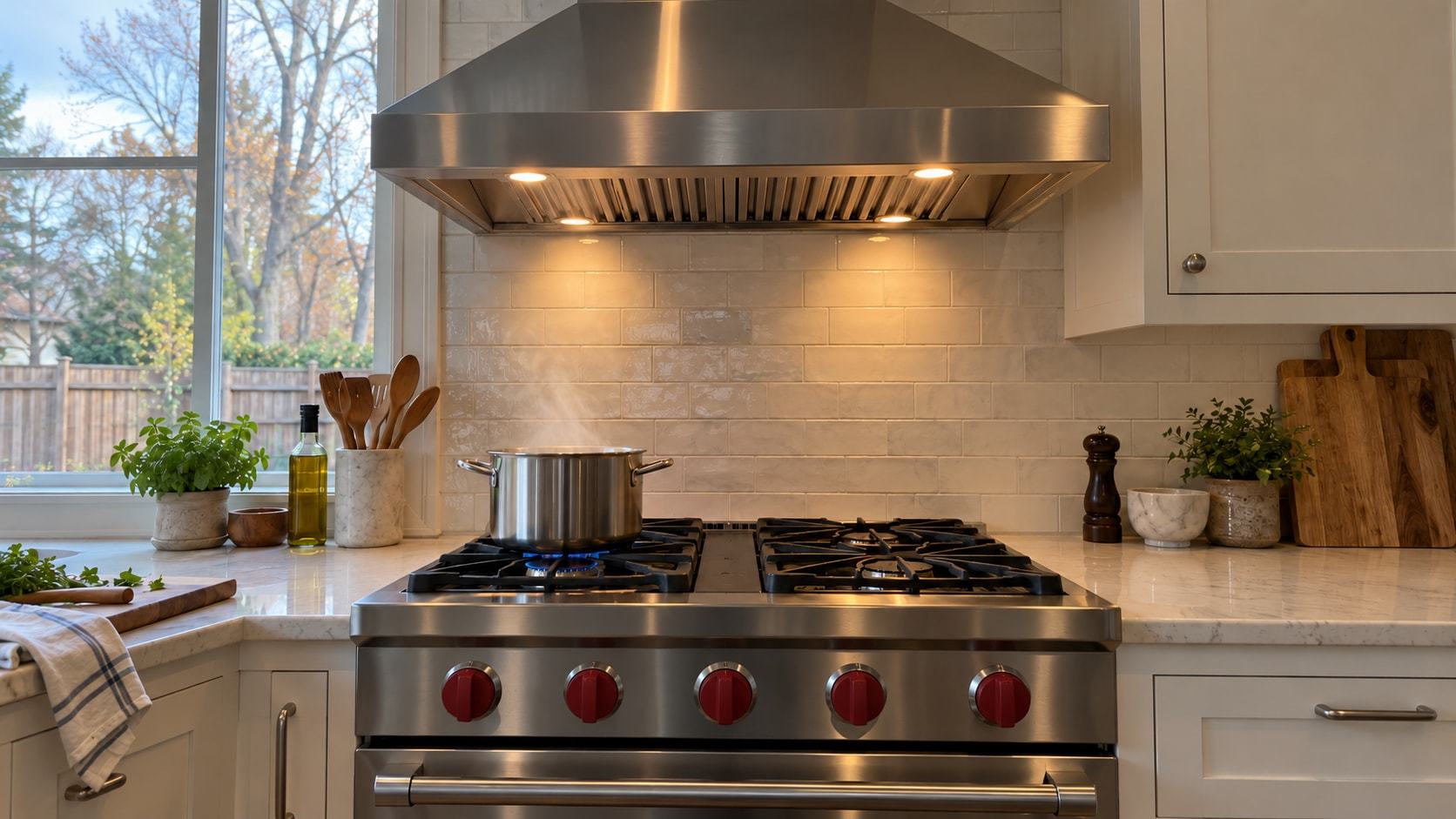
Why do all the fan speeds on my Wolf hood sound the same?
When low, medium and high all run at one speed, the part that sets the speed is the usual suspect: the speed control or the board that feeds the blower. A motor with worn windings can also fail to pick up speed, and on hoods with an automatic setting a faulty sensor can make the fan ignore changes. A breaker reset is the only owner check; the rest needs testing.
Wolf ventilation types and the parts that set them apart
Wolf ventilation comes in several shapes, and each adds a part or two the others do not have. Knowing which you own tells the technician what to bring.
| Type | Where it lives | Parts that set it apart | Typical complaint |
|---|---|---|---|
| Wall hood | Against a wall above a range or rangetop | Chimney cover, wall-mounted blower or a remote blower in the duct run | Weak draw from a long or kinked duct |
| Island hood | Hung from the ceiling over an island cooktop | Ceiling mount, open-sided canopy that loses capture to cross-drafts | Wobble on the mount, smoke escaping at the sides |
| Low-profile hood | Close above the cooking surface, under cabinets | Compact blower and controls close to the heat | Controls and lights affected by heat and grease |
| Ventilation insert | Built inside a decorative hood shell built by a cabinet maker | Insert body, filters and lights inside a shell that may hide the access | Hard-to-reach blower or wiring behind the decorative cover |
| Downdraft | Behind a cooktop, rising from the counter | Lift motor, guides and position switches; the blower sits below the counter | Chimney that sticks or will not rise |
Before you call: what you can check yourself
These checks are safe for any owner and often fix a weak or noisy hood on their own. Switch the hood off and let the filters cool before handling them.
- Take down the baffle or mesh filters and wash them; your use-and-care guide gives the method and interval for your model.
- If your hood runs in recirculating mode, check when the charcoal filters were last replaced; they cannot be washed and stop absorbing odor once saturated.
- Shine a light up past the filter opening and look for heavy grease on the blower housing.
- On a ducted hood, go outside and make sure the exterior cap opens when the fan runs and is not blocked by a nest, leaves or snow.
- Reset the breaker for a minute to clear a confused control panel.
- On a downdraft, clear anything sitting on top of the chimney or wedged in the gap behind it.
- Write down the model and serial number from the label, often visible once the filters are out, so the right parts can be checked.
Why is my Wolf downdraft stuck halfway or not rising at all?
The chimney is moved by its own lift motor, and the control depends on position switches to know where it is. When it stalls or will not move, the motor, its gear, a position switch or the control is the usual cause, and debris in the guides can jam it too. Do not force it up or down by hand, because that can strip the gear.
What happens on a ventilation visit
Each visit follows the same three stages we use on every Wolf appliance: diagnose, repair, then test every mode. On a hood the work runs roughly in this order.
- Arrival
The technician asks what you have noticed, then runs the hood through every speed and the lights while listening and watching the canopy capture steam.
- Filters and blower
Filters come down and the blower wheel and housing are inspected for grease load, balance and bearing play.
- Motor and controls
The motor, its capacitor, the speed control and the board are tested electrically, along with the light circuit and any auto-speed sensor.
- Air path
Damper flaps and the reachable duct are checked, and the exterior cap if it can be reached safely. On downdrafts, the lift motor, guides and switches are tested.
- Before any repair
You get the cause and the exact price for your unit, with the $89 service call credited. Nothing is replaced until you agree.
- Repair and final test
Parts on hand are fitted that visit; anything specific to your model is ordered for a return trip. The hood is then run at every speed with lights on, and a downdraft is cycled up and down several times.
Questions about Wolf hoods and downdrafts
Who repairs Wolf range hoods in Naperville and nearby suburbs?
We do. Our technicians work on Wolf wall, island and low-profile hoods, ventilation inserts and downdrafts across Naperville, Aurora, Wheaton, Lisle, Bolingbrook, Plainfield and Downers Grove.
My hood pulls weakly even with clean filters. What now?
Then the restriction is past the filters: a grease-loaded blower wheel, a damper stuck partly closed, a crushed or blocked duct, or a motor that has lost speed. Those need a technician to test and reach.
Is a noisy hood dangerous, or just annoying?
Usually annoying at first, but it is worth acting on. A wobbling wheel wears the motor bearings faster, and a hood that shakes on its mounts can loosen further. Grease-related noise also means grease is building up where it can catch fire.
Can you fix the lights on a Wolf hood?
Yes. If a new bulb or LED module does not solve it, we test the socket, the switch and the lighting circuit on the board.
Should I switch on the hood if I smell gas in the kitchen?
No. Do not touch any switch, the hood included, and do not operate the cooktop knobs. Leave the house, call the gas utility or 911 once you are outside, and call us after the line has been made safe.
Does a Wolf hood need regular professional service?
Filter care is an owner job. Beyond that, an annual check of the motor, wheel, controls and duct path is a sensible habit, especially for kitchens that do a lot of high-heat cooking. Our post on why ventilation matters explains what the hood is protecting.
My cooktop or range has a problem too. Can it be looked at on the same visit?
Yes. Mention it when you book so the technician plans for both. We repair Wolf cooktops and ranges as well, the $89 visit is charged once rather than per appliance, and the pricing page explains how it and the repair prices fit together.
Tell us what kind of hood you have and what it is doing. Call (872) 276-8585 any time or book a visit online; visits run daily, and if you would rather write first, the contact page lists every way to reach us.
Calls answered 24/7 · visits daily, 8:00 AM – 6:00 PM