Wolf wall oven repair for E Series and M Series ovens
A built-in oven sits inside your cabinetry, so its problems tend to cluster around the parts you touch and the parts you cannot see: the door, its gasket and lock, the convection fan behind the back wall, and the electronics above the door. We repair single and double Wolf wall ovens from both the E Series and the M Series. Phones are answered around the clock, and the $89 service call is credited toward the repair.
Rated 4.9 out of 5 from 187 customer reviews · read them
Why is my Wolf wall oven not heating to temperature?
When a Wolf wall oven stalls below the set point, the usual causes are a failed bake or convection element, a temperature sensor that reads wrong, a door gasket letting heat escape, or a control board that stops powering the elements. An oven thermometer reading and the exact display message help a technician narrow it down quickly.
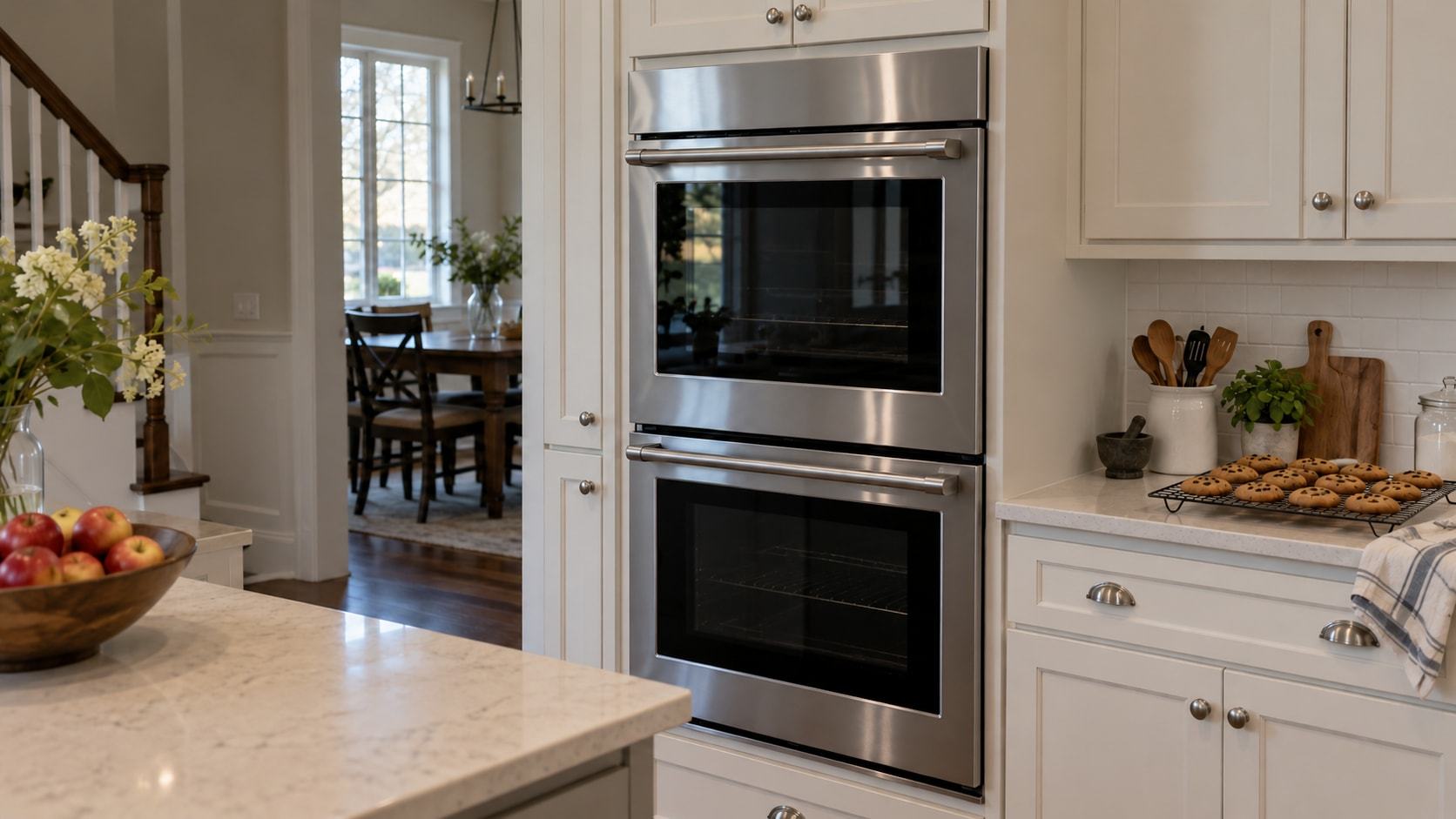
Before you call: five minutes that save a visit
A wall oven gives clues that disappear once it cools down or resets. Jot these down and the technician arrives knowing which parts to bring.
- The model and serial number from the oven's rating label, which on built-in ovens is usually visible with the door open. A phone photo is enough.
- Whether it is a single or double oven, and which cavity misbehaves if you have two.
- The mode you were using when it went wrong: bake, convection, broil, self-clean or a preset program.
- Anything on the display: an error code, a frozen screen, a message or a blank panel. Photograph it before resetting.
- How far it heats. Put an oven thermometer on the middle rack, set a moderate temperature, and note the reading once preheat says it is done.
- Sounds and smells: a silent convection fan, a grinding noise, or a burning smell that is not food.
- Whether the breaker for the oven has tripped, and whether it trips again when you reset it once.
Common wall oven faults and the parts behind them
These are the eight problems we see most on Wolf built-in ovens. Several look alike from the front, which is why testing beats guessing.
-
Will not heat at all, or heats in some modes only
Usually behind it: A failed heating element, a fault in the control board that switches it, or wiring to the element.
The way forward: If bake works but convection does not, say so: it points straight at one circuit.
-
Heats, but runs hot or cold against a thermometer
Usually behind it: The temperature sensor has drifted, or the control has lost its calibration.
The way forward: Often corrected with a sensor replacement or a calibration rather than a major part.
-
Convection fan silent, slow or noisy
Usually behind it: The convection motor, its fan blade or the circuit feeding it.
The way forward: Baking unevenly on convection settings is the usual first hint.
-
Broil does nothing
Usually behind it: The broil element or its supply from the board.
The way forward: Look up through the door: an element that never glows has a clear answer.
-
Heat or steam escapes around the door, or the glass gets very hot
Usually behind it: A worn or torn door gasket, or hinges and springs that no longer pull the door tight.
The way forward: A gasket check takes a minute on a visit and gaskets are a carried part.
-
Self-clean will not start, stops early, or the door will not unlock
Usually behind it: The door lock motor or its switch, a temperature reading the control does not trust, or the board.
The way forward: Let it cool fully. See the warning below.
-
Touch panel unresponsive, flickering or showing codes
Usually behind it: The control board, the display or its connection; sometimes a power interruption.
The way forward: Note the code and power the oven off at the breaker once, then call if it comes back.
-
Oven light out
Usually behind it: A bulb, its socket or the light circuit on the board.
The way forward: Usually small, but worth fixing in the same visit as anything else.
What do I do if my Wolf oven door is locked after self-clean?
Wait. The door stays latched until the cavity has cooled to a safe temperature, which takes a while after a high-heat cycle. If it is still locked once the oven is completely cool, switch the breaker off for a minute and back on. If it stays locked, call a technician rather than forcing it.
What happens from your call to a working oven
Most wall oven repairs are completed in one visit, typically an hour or two. A control board or another model-specific part is the usual reason for a second trip.
- When you call
We note the model, the mode and what you saw, then book a visit. Visits run daily from morning to early evening; calls are answered at any hour.
- First minutes on site
The technician listens to what happened, then runs the oven through bake, convection and broil to see the fault in action rather than rely on a description.
- Diagnosis
Elements, the temperature sensor, the convection motor, the door gasket and hinges, the lock and the control board are tested until the cause is confirmed. Both cavities are checked on a double oven.
- Before any work
You get the diagnosis and the exact price for the repair. The $89 service call is credited toward it if you go ahead.
- Repair
Parts the technician carries, such as gaskets, sensors and thermostats, are fitted on the spot. If a board or a model-specific part is needed, it is ordered and a return visit is booked.
- Final check
Every mode is run again, the temperature is confirmed against a reference, and the door is checked for a tight seal before the technician packs up.
Why is the convection fan on my Wolf M Series oven not working?
If the convection fan on an M Series oven will not spin, the cause is usually the fan motor, a fan blade rubbing or loose on its shaft, or the control board not sending power to the motor. A fan that hums but does not turn points to the motor itself; complete silence points to its supply.
What owners assume, and what usually turns out to be true
-
Heard often Uneven baking means the oven is broken.
In practice Sometimes, but check the simple things first: rack position, a pan too large for the airflow, or a convection fan that has quietly stopped. A thermometer reading tells you whether the oven itself is off.
-
Heard often If the display lights up, the control board is fine.
In practice A board can power the screen and still fail to switch an element or the lock. The board is tested under load, not judged by whether it glows.
-
Heard often A worn door gasket is only cosmetic.
In practice The gasket keeps heat in the cavity. When it flattens or tears, the oven works harder, preheats slowly and heats the cabinetry around it.
-
Heard often E Series and M Series ovens use the same parts.
In practice They share a brand, not a parts list. Controls, displays and many components are specific to the series and the model, which is why we ask for the model number first.
-
Heard often Running self-clean more often keeps the oven healthy.
In practice Self-clean runs the cavity much hotter than baking, and that heat is when a tired lock or element tends to give out. Wipe spills early and save the cycle for when it is needed.
Wall oven questions owners ask
Who fixes Wolf wall ovens in Naperville and nearby towns?
Naperville Wolf Kitchen Pros repairs only Wolf cooking equipment, including E Series and M Series built-in ovens, across Naperville, Aurora, Wheaton, Lisle, Bolingbrook, Plainfield and Downers Grove. Call (872) 276-8585 or book online.
Can you repair an older Wolf wall oven?
Yes. We work on older Wolf ovens as well as current ones, and parts can be found for most models. If a part for your oven is no longer made, we tell you after the diagnosis, before you commit to anything else.
My double oven has one cavity that works and one that does not. Is that one repair or two?
Each cavity has its own elements and sensor, so a fault in one does not usually involve the other. The technician tests both, explains what is wrong with each, and prices each repair before work starts.
How much does it cost to fix a Wolf wall oven?
Two things set it: which part failed, from a door gasket to a convection fan motor or a control board, and how the technician reaches it, since some parts come out from the front while others mean sliding the built-in oven out of the cabinet. The exact figure follows the inspection, and the $89 service call is credited toward it; the pricing page explains the rest.
What do Wolf oven error codes mean?
A code means the control has detected a fault in a sensor, the lock or a heating circuit. Write it down, reset the oven once at the breaker, and call if it returns. Our article on Wolf error codes explains why repeated resets are a bad idea.
Have the model number and what you saw on the display ready, then call (872) 276-8585 or book a visit online. If baking has been getting worse slowly, our article on signs an oven needs repair is worth a read. An oven that is part of a freestanding range is covered on Wolf range repair, and steam ovens on Wolf steam oven repair. Other ways to reach us are on the contact page.
Calls answered 24/7 · visits daily, 8:00 AM – 6:00 PM