Wolf microwave and microwave drawer repair
Most Wolf microwave calls start one of two ways: the drawer will not travel in or out the way it should, or the unit sounds busy while the plate comes out cold. The first is mechanical and partly visible. The second lives behind sheet metal next to stored high voltage, and that is where a homeowner should stop and a technician should start.
Rated 4.9 out of 5 from 187 customer reviews · read them
Why won't my Wolf microwave drawer open or close?
Usually the drawer is meeting resistance it reads as an obstruction: something wedged behind it, buildup on the slides, a tired drive motor or a position sensor that has lost track. Clear the track and reset the breaker once. If it still stalls at the same point, the slide, motor or sensor needs testing.
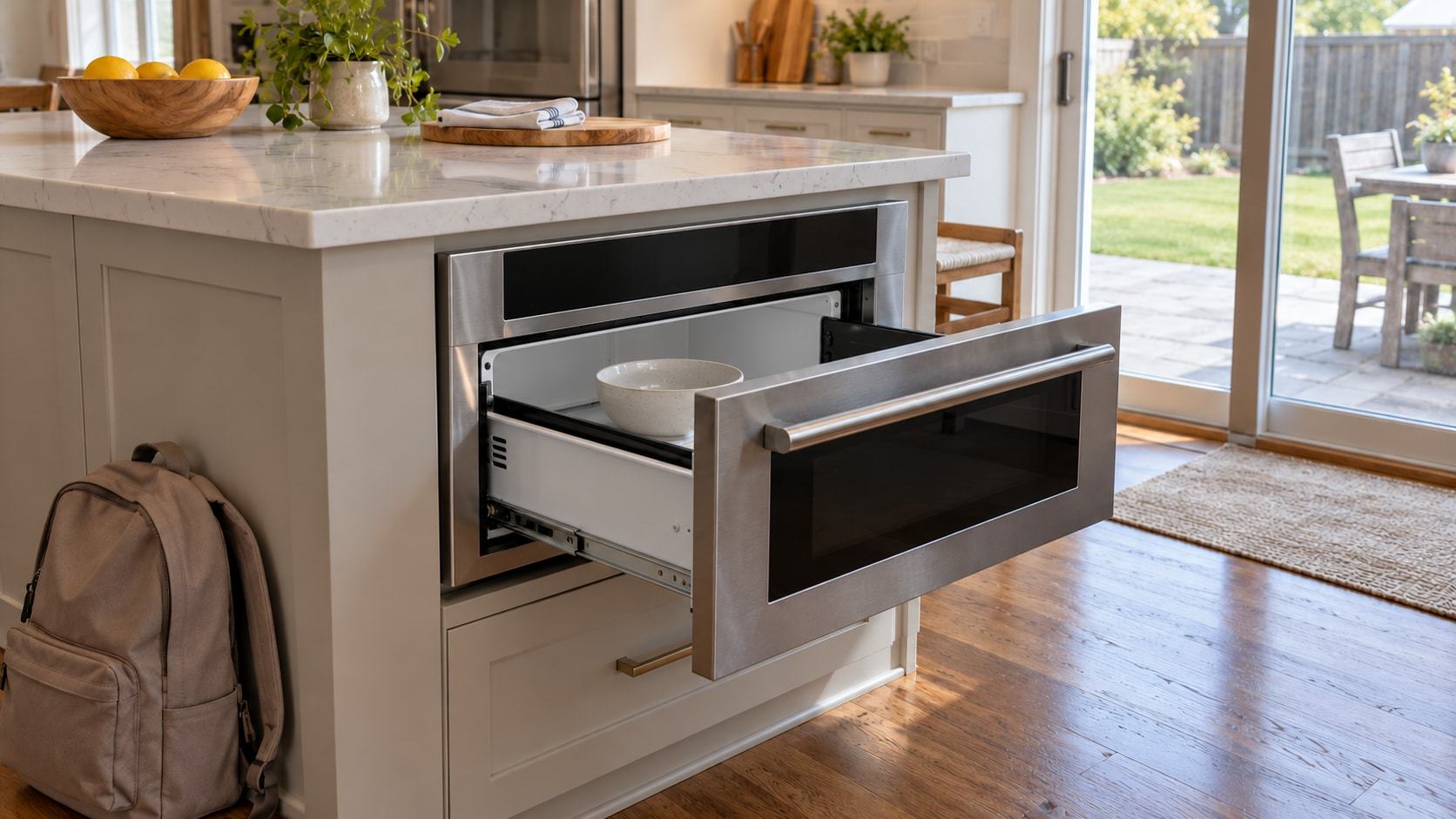
Drawer or built-in: which parts your model has
Wolf sells microwave drawers in 24-inch and 30-inch widths and a 24-inch built-in microwave. The heating chain is the same idea in all three, but the drawers add a powered mechanism the built-in does not have, and that changes what can go wrong.
| Assembly | Drawer, 24 or 30 inch | Built-in, 24 inch |
|---|---|---|
| Magnetron, high-voltage capacitor and diode | Yes, the heat source and the circuit that feeds it | Yes, same principle |
| Drive motor, slides and drawer position sensor | Yes, they move the drawer in and out on command | No, the door swings on hinges |
| Door or drawer interlock switches | Yes, they confirm the drawer is fully shut before heating | Yes, they confirm the door is latched |
| Turntable motor and coupling | No turntable in a drawer cavity | Depends on the exact model; checked if fitted |
| Waveguide cover | Yes, a small panel where energy enters the cavity | Yes |
| Control board and keypad | Yes | Yes |
| Removal for repair | Some drawer jobs mean sliding the whole unit out of the cabinet opening | Usually serviced in place or after removing the trim |
Symptoms and the part behind each one
Read this as a shortlist, not a verdict. Several faults share a symptom, and only a test with the right meter on a discharged circuit separates them.
-
Fan and light run, the timer counts down, food stays cold
Usually behind it: Magnetron, high-voltage capacitor, high-voltage diode, or an interlock switch that never confirms the door is shut.
The way forward: Stop running test cycles. Repeated runs with a failing high-voltage part can damage the next part in line.
-
Drawer stalls partway, moves in jerks, or reverses on its own
Usually behind it: Worn or fouled slides, a weakening drive motor or its gear, or a position sensor reading the drawer in the wrong place.
The way forward: Look behind and under the drawer for a towel or utensil, then wipe the visible track. If the stall repeats at the same spot, book a visit.
-
Sparks or flashes inside the cavity
Usually behind it: Metal in the load, or a grease-soaked, carbonized waveguide cover. Damaged cavity coating can arc too.
The way forward: Do not run it again until the cause is found. A burn spot that keeps arcing can spread to more expensive parts.
-
Keypad ignores some or all presses
Usually behind it: Control lock left on, a worn membrane on the most-used keys, or the control board.
The way forward: Check the lock, then switch the breaker off for a minute. Dead keys after that point to the panel or the board.
-
Loud buzz, hum or grinding during a cycle
Usually behind it: A failing diode or magnetron when heating is weak too; the drive gear or a fan when the noise follows the drawer movement.
The way forward: Note when the sound starts. It helps the technician narrow it down before any panel comes off.
-
Starts, then quits when the drawer or door is touched
Usually behind it: Latch or interlock switch out of adjustment, or a drawer that stops a few millimetres short of closed.
The way forward: Never hold the drawer shut or press the latch to make it run.
-
Cavity light stays dark, everything else works
Usually behind it: Bulb or socket in most cases; occasionally the light circuit on the board.
The way forward: Low priority. Mention it when booking so the right bulb is on hand.
Why does my Wolf microwave hum but leave the food cold?
The hum tells you the fan and the high-voltage circuit are switched on, but microwave energy is not reaching the food. A failed magnetron, capacitor or diode is the usual reason, or a door interlock switch that blocks heating because it reads the door as open. Each part is tested on its own, after the capacitor has been safely discharged.
Things owners believe about microwave repair
-
Heard often Unplugging it makes the inside safe to work on.
In practice Power off does not drain the capacitor. Technicians discharge it with an insulated tool and confirm it is empty before touching anything in that compartment.
-
Heard often A blown internal fuse is a quick swap.
In practice That fuse rarely fails alone. Something downstream, often a switch or a high-voltage part, usually took it out, and a new fuse on its own tends to blow again on the first cycle.
-
Heard often If it sparked once, the whole unit is finished.
In practice Many sparking calls end with a new waveguide cover and a cleaned cavity. The verdict depends on whether the arc burned through the coating or reached anything behind it.
-
Heard often A stuck drawer always means a dead motor.
In practice Slides gummed with spills, a bent rail or a confused position sensor stop the drawer just as well. The motor is one of several candidates, not the default answer.
From the first call to a microwave that heats again
Every repair we do follows the same three stages: find the cause, fix it, then prove every function works. On a microwave the order inside those stages matters because of the stored charge.
-
Listen to the history, then look from the outside
The technician asks what you saw and when, checks the drawer travel or door latch, and reads any code on the display before a single screw comes out.
-
Isolate power and discharge the capacitor
The breaker goes off, the cabinet is opened, and the capacitor is discharged and confirmed empty. Only then does testing start inside.
-
Test the heating chain in order
Interlock switches first, because they are the easiest to reach and the most common cause; then diode, capacitor and magnetron. On drawers, the motor, slides and position sensor are checked separately.
-
Agree on the repair before any work
You hear which part failed and the exact price for this unit, credited with the $89 visit, and you decide. If the part is not on the truck, it is ordered and fitted on a return trip.
-
Repair and run every mode
After the fix the unit heats a load, the drawer cycles open and closed several times, and the keypad, light and interlocks are checked before the technician leaves.
What shapes the price of a microwave repair
We do not quote microwave repairs over the phone because one complaint can trace back to a switch or to a magnetron. These are the things that move the final figure.
-
Which part failed
An interlock switch, a waveguide cover and a magnetron are very different jobs in parts and in time.
-
Drawer or built-in
Drawer mechanism repairs involve the motor, slides or sensor, which built-in units do not have.
-
Whether the unit must come out
Some drawer repairs require sliding the microwave out of its opening, which adds labor on site.
-
Part on the truck or ordered
Common parts may travel with the technician; a control board for a specific model often has to be ordered, which means a second visit.
-
Secondary damage
An arc that has scorched the cavity, or a fuse taken out by another failure, can add a second item to the repair.
$89 service call, credited toward the repair. The exact price is set after the technician inspects the appliance.
Why is my Wolf microwave drawer not responding to the touch panel?
Check two things first: that the control lock is not switched on, and that a single breaker reset does not bring the panel back. If it still ignores touches or stays dark, the fault is in the controls or in a drawer or door switch the board waits on before it will run. Those parts sit behind panels next to high-voltage components, so testing them is a technician's job.
Where the microwave sits in the kitchen changes the job
A drawer under an island counter or below a cooktop is easy to reach for testing but awkward to remove. The technician works at knee height, and if the unit has to come out, the cabinet opening and the anti-tip parts are checked on the way back in so the drawer runs level. A drawer that sits even slightly out of square will rub its slides and stall again.
A built-in 24-inch model in a cabinet column, often above a wall oven or beside a steam oven, is reached from a ladder or step and is usually serviced through its trim. If another Wolf appliance in the same column is acting up, say so when you book so both can be looked at on the same visit, under a single $89 service call.
Before the visit, find the model and serial label if you can. On drawers it is usually visible with the drawer open; on built-ins it is often on the frame behind the door. Those two lines let us check parts for your exact unit instead of guessing. For questions about how the bill is built, the pricing page explains it, and anything else goes through the contact page.
Microwave questions we hear on the phone
Do you work on Wolf microwave drawers, or only built-in models?
Both. We repair the 24-inch and 30-inch Wolf microwave drawers and the 24-inch built-in microwave, including the drawer motor, slides and position sensor that only the drawers have.
My Wolf microwave drawer opens halfway and stops. Is it the motor?
Not necessarily. Check for anything caught behind the drawer first. If the track is clear and it stops at the same point every time, the slide, the motor and the position sensor all need testing before anyone names a part.
There were sparks inside my Wolf microwave. Can I keep using it?
Not until the cause is known. If there was metal in the dish, remove it and look for a scorch mark. If nothing metal was inside, have the waveguide cover and cavity coating inspected before the next use.
Is it worth repairing a Wolf microwave drawer instead of replacing it?
That depends on which part failed and what else is worn, so we answer it after diagnosis, with the exact repair price in front of you. Switches, covers and drawer parts are usually reasonable repairs; a magnetron on an older unit deserves a conversation.
What should I do if my microwave starts smoking?
Keep the door or drawer closed, stop the cycle and switch off the breaker if you can reach it safely. If there are flames that do not die out, leave the kitchen and call 911. For a unit that smoked and stopped, our urgent repair page explains what happens next.
How do I book a Wolf microwave repair in Naperville?
Call (872) 276-8585, answered around the clock, or book a visit online. Home visits run daily from 8 AM to 6 PM, and the $89 service call is credited toward the repair.
Tell us whether it is a drawer or a built-in and what it is doing. Call (872) 276-8585 or book a visit online; the $89 visit is credited toward the repair, and the exact price is set once the technician has tested the unit.
Calls answered 24/7 · visits daily, 8:00 AM – 6:00 PM